How Trump New Import Tariffs 2025 Could Reshape Prices, Jobs, and Everyday Life for U.S. Consumers
Understand how Trump new import tariffs 2025 could influence prices, jobs, and daily costs for U.S. consumers through a clear, insight-driven breakdown. A concise preview explaining the real economic shifts to watch.

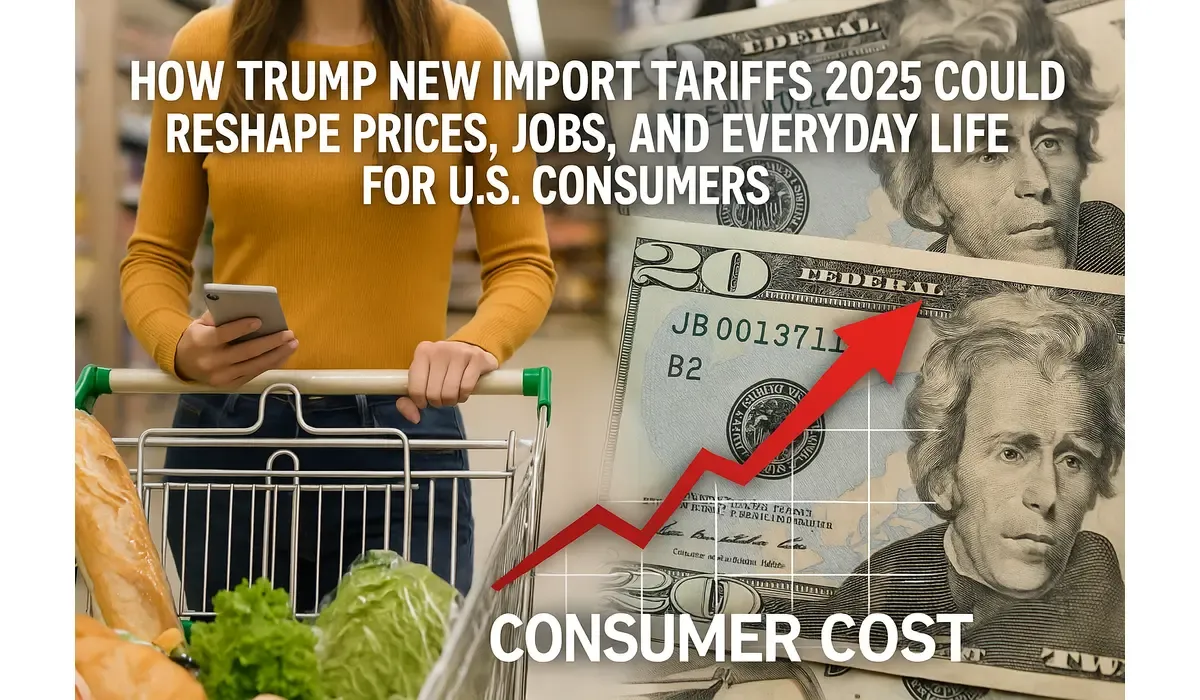
Trump new import tariffs 2025 are at the center of economic debate—and your wallet may feel the difference first. From furniture and trucks to life-saving medicines, these tariffs will reshape what Americans pay and how households budget in the months ahead.
- Household costs could rise by over $2,000 per year.
- Inflationary ripple effects may last beyond 2025.
- Consumers, businesses, and jobs face major adjustments.

Latest Update: What’s Included in the 2025 Tariffs?
- 100% tariffs on pharmaceutical imports.
- 50% tariffs on kitchen cabinets and bathroom vanities.
- 30% tariffs on upholstered furniture.
- 25% tariffs on large imported trucks.
- Reviews underway for semiconductors, medical devices, and timber products.
These policies build on earlier tariffs in 2025 that already hit steel, aluminum, and select manufactured goods.

$750 Amazon Gift Card
Not everyone qualifies for this $750 Amazon gift card. Checking only takes a moment. You can check if you’re eligible.
Key Details & Price Effects
- Inflation impact: Prices could rise 1.5–1.8% overall.
- Household loss: Studies estimate ~$2,100–$2,400 annual income-equivalent loss per U.S. household.
- Consumer burden: About 70% of tariff costs are already passed through to U.S. buyers.
- GDP drag: Growth may slow 0.5 p.p. in 2025–2026, with ~505,000 fewer jobs by end of 2025.
- Regressive impact: Lower-income households spend a bigger share of income on tariff-affected goods.
Why It Matters to Everyday Consumers
- Higher medicine bills: With 100% tariffs on drugs, patients could see prices double.
- Costlier home projects: Furniture, vanities, and cabinets may carry 30–50% surcharges.
- Budget squeeze: Average households could lose the equivalent of $2,000+ annually.
- Job market pressure: Import-dependent industries may cut staff as costs mount.
- Wider inflation drag: Even unrelated goods may climb in price due to higher supply chain costs.
Comparison With Other Trade Tools
| Tool | Pros | Cons |
|---|---|---|
| Tariffs | Protects local industries, raises revenue | Inflationary, regressive, sparks retaliation |
| Subsidies | Boosts U.S. production without raising consumer prices | Adds fiscal burden |
| Trade deals | Long-term stability, lower costs | Slow to negotiate |
| Import quotas | Caps foreign reliance | Market distortion, limited consumer choice |
Expert Views on the Tariffs
- Yale Budget Lab: Projects $2,100–$2,400 household cost increases.
- Tax Foundation: Calls tariffs a “hidden tax,” averaging $1,300 per household.
- Peterson Institute: Notes that 70% of tariff costs are already being passed to consumers.
- American Progress: Warns of a “turbulence tax” undermining growth and stability.
What Consumers Should Do
- Plan budgets early: Expect higher bills in health care, housing, and transportation.
- Consider U.S.-made options: Domestic goods may become more competitive.
- Stock up wisely: Nonperishables and durable goods might be cheaper before tariffs bite.
- Stay informed: Watch for tariff exemptions or legal reversals.
- Monitor investments: Retail, automotive, and pharmaceutical sectors face volatility.

$500 Walmart Gift Card
Some users qualify for a $500 Walmart gift card. You can check if you qualify.
FAQs
Q1. Will Trump new import tariffs 2025 raise prices for all goods?
Not all, but many consumer staples—especially in health, furniture, and transport—will rise sharply.
Q2. How much will an average family lose?
Analysts estimate $2,100–$2,400 in annual costs, depending on consumption patterns.
Q3. Can Congress block these tariffs?
Yes, Congress or courts could intervene, but most tariffs stand unless legally overturned.
Q4. Will tariffs create more U.S. jobs?
In some industries, possibly. But net job losses are expected due to higher costs and reduced demand.
Conclusion
The Trump new import tariffs 2025 are reshaping the American consumer landscape. Prices are set to climb, household budgets will tighten, and job markets may face turbulence. While the policy is pitched as protectionist, its most immediate effect will be on the wallets of ordinary Americans.