Apple MacBook Pro 2025 M5 Benchmarks & Specs
Get a focused look at Apple MacBook Pro 2025 M5 benchmarks and specs, highlighting performance gains, efficiency improvements, and real-world workload results. This concise breakdown shows what the new chip truly delivers.


Introduction
Apple MacBook Pro 2025 M5 benchmarks and specs are already making waves in tech circles following the official reveal. With the jump to the M5 chip, what real performance gains can users expect in 2025?
From the announced architecture to early benchmark leaks, this review breaks down the data and what it means for creative professionals, developers, and power users.
| Apple MacBook |
|---|
| Apple MacBook Pro M5 chip AI performance review 14-inch MacBook Pro M5 vs M3 speed comparison |
What Is the Apple MacBook Pro 2025 with M5?
The Apple MacBook Pro 2025 with M5 is the refreshed 14-inch MacBook Pro model that replaces the previous M4 chip, preserving the chassis and display design but upgrading internals significantly.
Apple positions it as a performance-oriented laptop suitable for demanding workflows, while keeping its heritage of long battery life and efficient silicon.
Latest Update: Official Specs & Performance Claims
On October 15, 2025, Apple officially announced the new MacBook Pro with M5. Apple Key official specs include:
- Chip configuration: 10-core CPU (4 performance cores + 6 efficiency cores)
- GPU: 10-core GPU, with a Neural Accelerator embedded in each core
- Neural/Machine Learning: 16-core Neural Engine
- Memory bandwidth uplift: Higher bandwidth vs. M4 (some claims mention 153 GB/s)
- Storage: Base 512 GB SSD, with up to 4 TB option
- Battery life & design: Apple claims the same up to 24 hours of battery life, and externally the design, ports, display remain unchanged.
On the performance side, Apple advertises:
- Up to 1.6× faster graphics compared to M4
- Up to 3.5× performance boost in AI / machine-learning workloads
- Around 20% multi-core CPU gains in certain workflows
Because external design stayed the same (same display, ports, battery), much of the leap depends entirely on silicon advancements.
Details, Features & Benchmark Insights
Chip Architecture & Design
The M5 retains the same core counts as M4 (10 cores) but focuses on enhanced efficiency, higher bandwidth, and built-in AI improvements.
It’s built on a 3 nm process node (TSMC’s N3P) and includes hardware for ray tracing and better GPU compute.
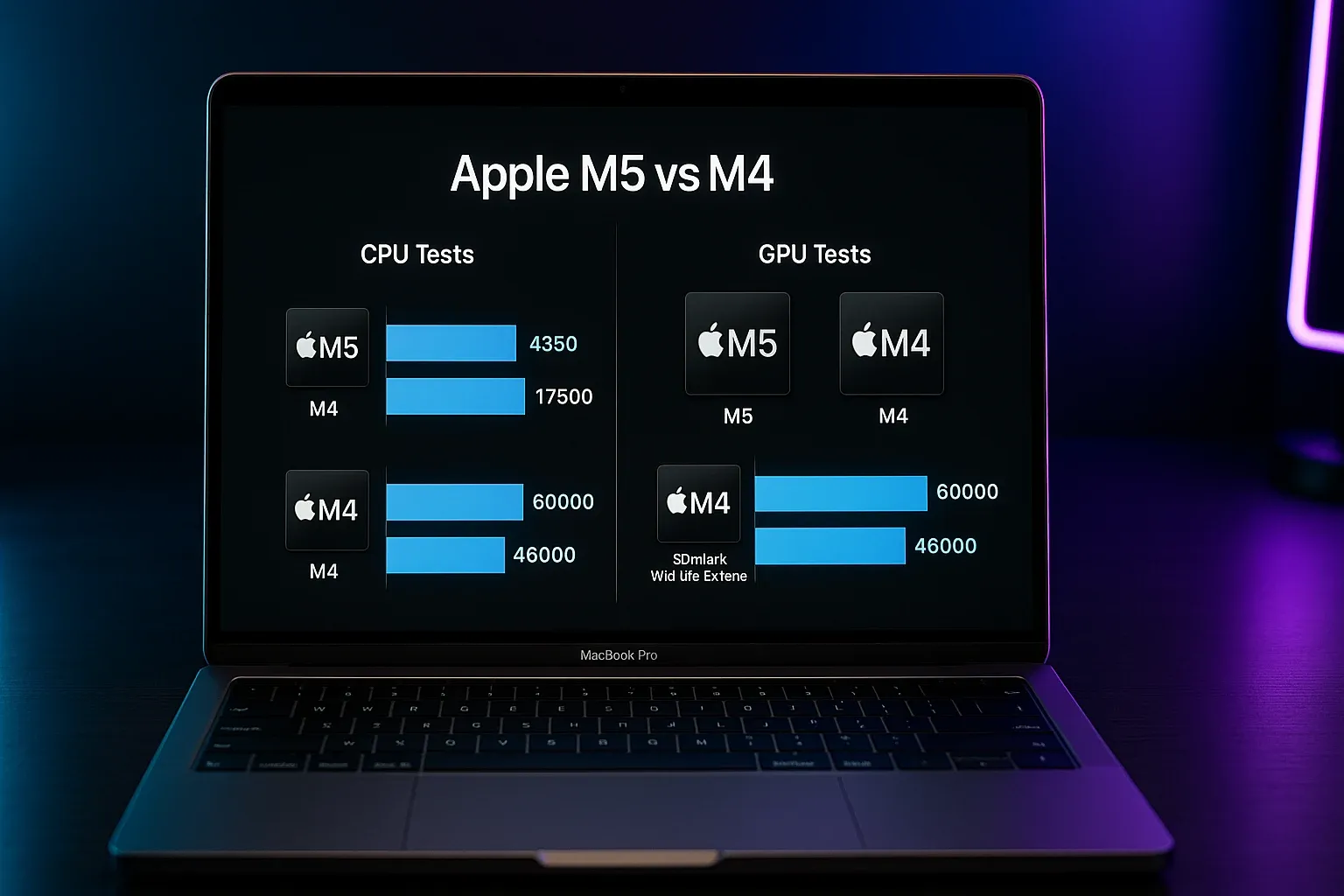
Benchmark Data & Real World Leaks
While full independent reviews are still forthcoming, some leaks and early tests hint at strong performance:
- Notebookcheck reports that in single-core performance, the M5 ranks at the top among tested devices in their early benchmarks.
- Comparisons with M4 show modest uplift rather than a radical leap, especially in CPU actions.
- The GPU and AI gains seem to be the more aggressive improvements, with claims of 4× peak GPU compute over M4 in certain tasks.
- Storage speed is doubled, per Apple’s claims, which will benefit tasks like video editing and asset loading times.
Given that the chassis, display, and battery tech are unchanged, the new M5’s gains primarily shine in compute-bound, GPU or ML tasks.
Other Features & Constraints
- The same 14.2-inch Liquid Retina XDR display with ProMotion and optional nano-texture glass remains.
- Ports, camera, and connectivity (Wi-Fi, Bluetooth) stay consistent with prior models.
- Because the design is unchanged, cooling and thermal characteristics may limit peak sustained performance compared to potential full redesigns.
- The upgrade to 4 TB SSD as option may push pricing steeply.
Why This Upgrade Matters
Better GPU & AI Workflows
For users in areas like video editing, 3D rendering, and machine learning tasks, the M5’s GPU enhancements and neural accelerators will provide tangible gains. The 1.6× graphics boost claim suggests richer visuals and faster rendering pipelines.
Sustained Value Without Sacrificing Battery Life
Keeping the same battery and chassis, Apple aims to deliver higher throughput without sacrificing endurance. For professionals working on the go, that consistency matters more than cosmetic changes.
Incremental vs Radical Upgrade
While this isn’t a generational leap in form factor, it gives existing MacBook Pro users a worthwhile incentive to upgrade—especially for those pushing their machines in creative workloads. For newer buyers, the improved performance-to-cost ratio makes it more competitive.
Comparisons & Alternatives
| Model | Chip / Variant | Notable Strength | Consideration |
|---|---|---|---|
| MacBook Pro M4 (2024) | M4 (10-core) | Already excellent for many tasks | M5 may not feel huge jump in everyday tasks |
| MacBook Pro M5 Pro / Max (rumored) | High-end M5 variants | Higher core counts, stronger GPUs | Likely to appear in 2026, and cost more |
| MacBook Air (M5, future) | Lighter, less thermal headroom | More portable | Tradeoffs in sustained performance |
| High-end Windows laptops | Intel / AMD alternatives | Potential advantage in specific workflows (e.g. GPU compute) | Differences in OS, software compatibility |
If you’re debating between upgrading from M4 or waiting for M5 Pro/Max, consider what tasks you do most. If your workflows are GPU-heavy or AI-centric, the base M5 already brings noticeable gains.
What Readers Should Do
- Wait for independent benchmarking before upgrading, especially for your specific workflows (video, 3D, code)
- Target heavier tasks (GPU, rendering, ML) to stress test improvements
- Compare cost vs benefit—if prices for 4 TB or upgraded memory inflate the cost exorbitantly, evaluate whether gains justify it
- Look out for future Pro / Max variants in 2026 if you need more cores or performance
- Watch thermals and thermal throttling in early reviews to see how performance sustains under load
FAQs
Q: What are the Apple MacBook Pro 2025 M5 benchmarks and specs?
You’ll find the focus keyword here: published data shows 10-core CPU, 10-core GPU, 16-core Neural Engine, doubled SSD speeds, and a 1.6× graphics boost claim.
Q: How does M5 compare to M4 in the MacBook Pro?
M5 brings higher memory bandwidth, better GPU compute, and stronger AI performance, but the base architecture (core count, chassis) remains similar.
Q: Will there be significant battery life change in M5 MacBook Pro?
No. Apple maintains the same 24-hour battery life claim, despite internal upgrades.
Q: When will the MacBook Pro M5 Pro / Max arrive?
Rumors suggest those higher variants could launch in early 2026.
Conclusion
In the Apple MacBook Pro 2025 M5 benchmarks and specs landscape, we see a measured, internal upgrade—leveraging silicon strategy over radical design changes. If your workload benefits from GPU, rendering, or ML gains, the M5 is a promising jump. For lighter users, the differences may feel subtle day to day. Prepare to dive into independent reviews once more benchmarks arrive, and plan your upgrade based on how deeply you push your machine. What’s your take? Share below.