7 Powerful Apple M5 Silicon Features That Redefine Next-Gen Computing
Discover the powerful Apple M5 silicon features reshaping next-gen computing—from advanced efficiency cores to breakthrough AI performance. This concise, research-driven preview highlights the innovations every user should watch closely.

The Apple M5 silicon features that redefine next-gen computing introduce a new era of efficiency, intelligence, and performance. Built on a 3 nm architecture, Apple’s fifth-generation silicon marks a revolutionary leap in AI integration, graphics processing, and energy optimization.
The M5 isn’t just faster—it’s smarter, cooler, and purpose-built for the future of computing.
- Up to 45% graphics boost and 4× AI acceleration
- Unified architecture for CPU, GPU, and Neural Engine
- Based on a 3 nm fabrication process for peak efficiency
Quick Context
The Apple M5 silicon chip is Apple’s latest custom silicon designed for Macs, iPads, and spatial devices like Vision Pro. It continues Apple’s mission to create a unified computing ecosystem—where CPU, GPU, and AI processing coexist seamlessly.
The Apple M5 silicon features that redefine next-gen computing include faster performance cores, redesigned GPU clusters, and an AI-focused architecture that enables on-device intelligence.
It sets the foundation for next-gen Macs, bringing desktop-class performance to ultra-efficient mobile platforms.
Latest Post
Core Architecture and Processing Power
1. 3 nm Node Efficiency
Apple M5 silicon shift to a 3 nm process allows more transistors in the same die area, resulting in superior performance-per-watt efficiency.
Users can expect up to 25% faster CPU performance and longer sustained workloads without overheating.
2. Enhanced CPU & GPU Integration
The M5 combines a 10-core CPU (four performance + six efficiency cores) and a 10-core GPU, tightly integrated with the unified memory system.
This means real-time data exchange between CPU and GPU—perfect for high-end rendering, gaming, and machine learning tasks.
3. AI-Optimized Neural Architecture
Each GPU core now includes embedded neural accelerators, enabling the M5 to perform AI inference and image generation tasks up to four times faster than M4.
This change redefines what “smart computing” means—on-device machine learning without relying on cloud processing.
Breakthrough Features That Define the M5
4. Dynamic Caching and High Bandwidth Memory
The M5 supports a new 153 GB/s unified memory bandwidth, reducing latency and allowing seamless multitasking.
Applications like 8K video editing, 3D modeling, and large AI models now run without bottlenecks.
5. Ray Tracing and Enhanced Graphics Pipeline
The M5’s GPU includes third-generation ray tracing, mesh shading, and global illumination technologies, creating photorealistic rendering in games and pro apps.
With up to 45% more graphics performance, visuals appear more fluid and lifelike, even at ultra-high resolutions.
6. Neural Engine for Generative AI
Apple’s Neural Engine in the M5 can process over 20 trillion operations per second, enabling generative AI, voice synthesis, and computer vision tasks.
This integration means AI-driven photo editing, natural language tools, and real-time translation will happen instantly on your device.
7. Scalable Architecture for Future Devices
The M5 design supports scalable configurations—M5 Pro, M5 Max, and M5 Ultra variants will extend its performance spectrum.
This ensures Apple’s ecosystem—from iPads to Mac Studios—remains interconnected with consistent power efficiency and performance behavior.
Why the M5 Redefines Next-Gen Computing
The Apple M5 silicon features that redefine next-gen computing represent more than incremental progress—they signal a structural transformation in how computing power is distributed and optimized.
A Unified Intelligence Model
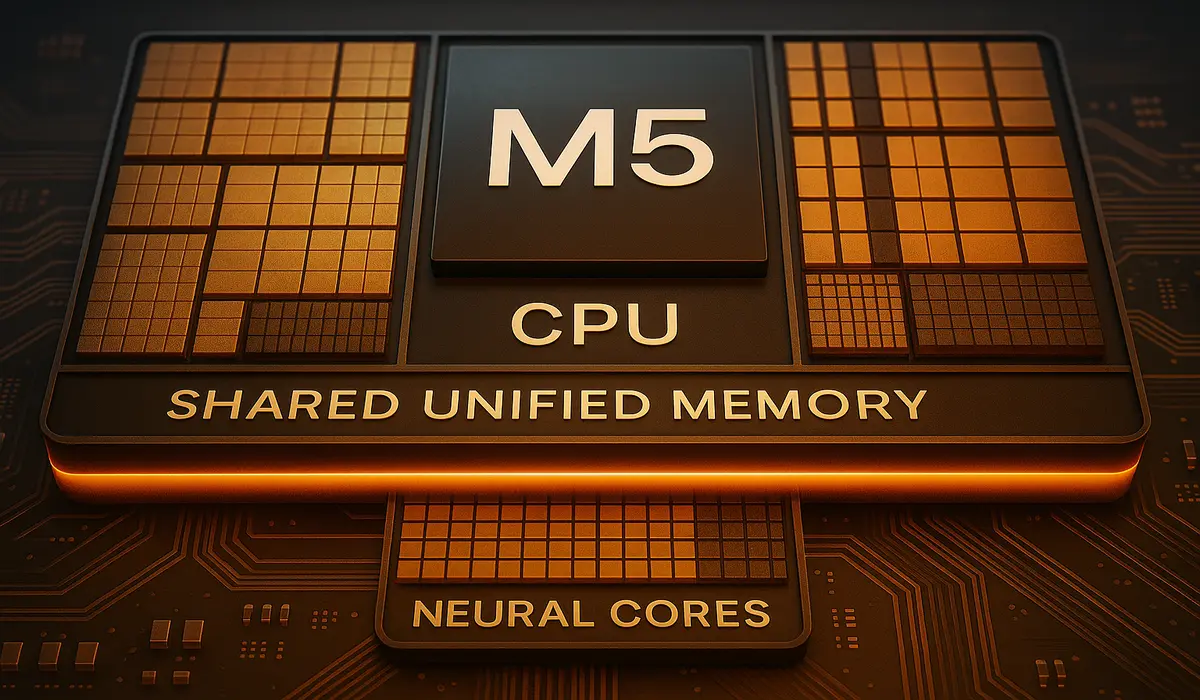
Unlike traditional chips, M5 unifies CPU, GPU, and Neural Engine within a shared memory system. This integration eliminates latency and ensures faster AI inference without energy spikes.
Power Efficiency Meets High-End Performance
Apple’s M5 silicon achieves peak performance with minimal power draw, extending device battery life and improving sustained performance for professionals.
AI at the Core
From predictive computing to adaptive rendering, the M5 enables a new generation of smart applications that learn user behavior and adjust dynamically.
Future-Proof Ecosystem
Whether for creators, developers, or gamers, M5 ensures that macOS and iPadOS can handle intensive workloads while staying thermally efficient.
Comparing M5 vs Previous Generations
| Feature | M4 | M5 | Improvement |
|---|---|---|---|
| Process Node | 3 nm (Gen 1) | 3 nm (Gen 3) | Higher transistor density |
| CPU Cores | 9-core | 10-core | +11% throughput |
| GPU Performance | Baseline | +45% faster | New ray tracing units |
| Neural Engine | 16-core | Integrated AI per GPU core | 4× AI acceleration |
| Memory Bandwidth | 120 GB/s | 153 GB/s | 27% boost |
This evolution makes the M5 the most balanced Apple silicon yet, merging extreme performance with advanced efficiency.
Practical Takeaways for Users
- Upgrade Ready: Wait for upcoming MacBook Pro and iPad Pro models with M5 chips for the full experience.
- AI Power at Home: Expect smoother local AI processing—no cloud dependency.
- Creative Workflows: Video editors, 3D designers, and musicians will see faster rendering and export times.
- Sustainable Performance: The M5 runs cooler, enhancing longevity and reducing energy waste.
FAQs about Apple M5 silicon features
Q1: What are the key Apple M5 silicon features that redefine next-gen computing?
A: 3 nm efficiency, 10-core CPU and GPU, embedded neural accelerators, faster memory bandwidth, and advanced AI capabilities.
Q2: How much faster is M5 compared to M4?
A: The M5 offers up to 45% more GPU performance and 4× better AI computation.
Q3: Which devices will use the M5 chip?
A: The upcoming MacBook Pro, iPad Pro, and Vision Pro 2 are expected to debut with M5 variants.
Q4: Is M5 suitable for gaming or AI development?
A: Yes. With hardware-level ray tracing and neural integration, it’s ideal for both high-end gaming and AI workloads.
Key Takeaways
- Apple M5 silicon features that redefine next-gen computing bring the biggest generational leap in Apple chip design.
- The 3 nm process, neural GPU architecture, and memory optimization enhance every aspect of computing.
- M5 enables sustainable, AI-driven, and graphics-rich performance for professionals and creators.
- It marks the shift from faster chips to smarter systems.
Conclusion about Apple M5 silicon features
The Apple M5 silicon features that redefine next-gen computing establish a new benchmark in performance, AI intelligence, and thermal efficiency. By combining next-level design with Apple’s ecosystem, the M5 proves that the future of computing is not just about power—it’s about balance, adaptability, and intelligence.