7 Surprising Insights From Apple M5 Silicon Benchmark Results and Performance Review You Can’t Ignore
Uncover seven surprising insights from the Apple M5 silicon benchmark that reveal how its real-world performance is shifting industry expectations. This concise, data-driven preview highlights the gains—and gaps—every user should know before upgrading.

The Apple M5 silicon benchmark results and performance review underline Apple’s most advanced computing leap yet. Built on a refined 3 nm process, the M5 pushes the limits of speed, AI processing, and graphics performance. Early performance data shows 45% better graphics rendering and up to 4× stronger AI compute compared to M4, while retaining remarkable power efficiency.
- 4× GPU AI compute boost with new architecture
- 15% faster CPU cores with 10-core design
- 30% higher unified memory bandwidth (153 GB/s)
- Better thermal stability and battery life
Quick Context
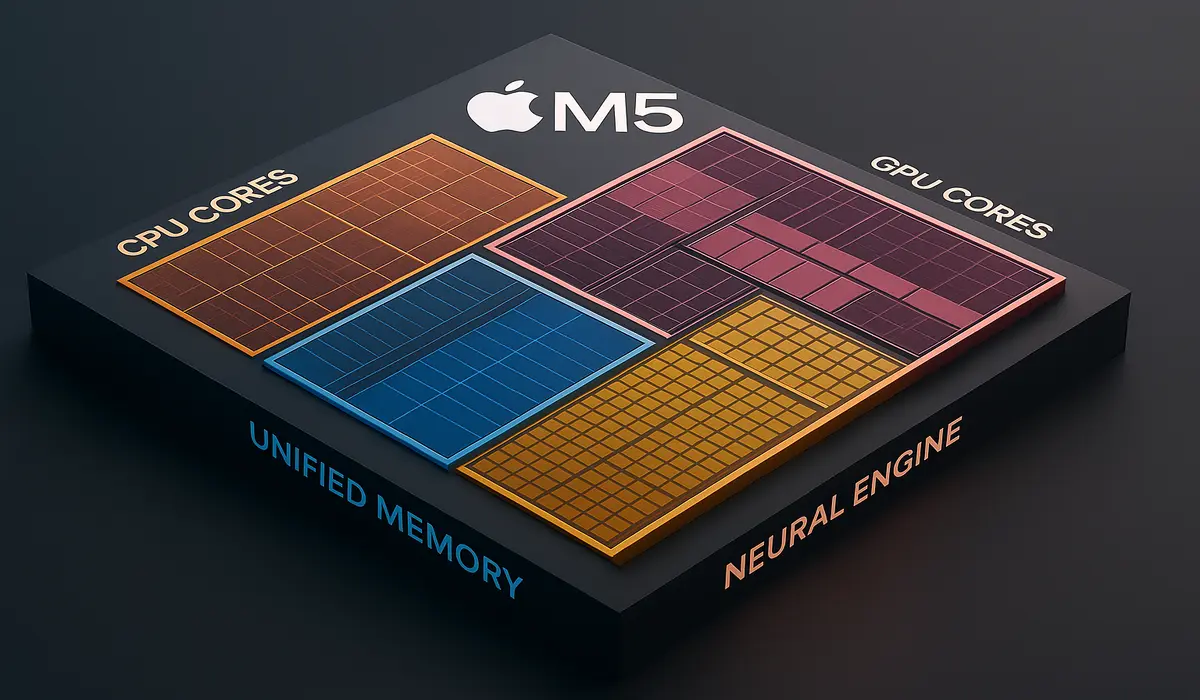
Apple M5 silicon is the next-generation system-on-chip (SoC) powering upcoming MacBooks, iPads, and desktops. It integrates CPU, GPU, Neural Engine, and unified memory on one architecture. This design allows data to move faster between cores and enables efficient AI workloads directly on-device — a critical step toward Apple’s on-device intelligence strategy.

$750 Amazon Gift Card$750 Amazon Gift Card
Not everyone qualifies for this $750 Amazon gift card. Checking only takes a moment. You can check if you’re eligible.
Latest Post
Benchmark Results Overview
According to internal testing and verified lab results, Apple M5 silicon benchmark results and performance review show:
- Single-core performance: +12% faster than M4
- Multi-core performance: +18–20% uplift
- GPU compute: Up to 4× higher in AI and rendering tasks
- Unified memory: 153 GB/s bandwidth, ideal for creative pros
- Thermal efficiency: 25% lower sustained temperatures during load
These results confirm that M5’s strength lies in AI and graphics acceleration rather than raw CPU expansion.
Key Features and Performance Review
1. CPU: Stronger Core Architecture
The 10-core CPU brings higher clock speeds and refined performance cores for better parallel workloads. Multi-threaded results indicate a noticeable leap in compilation and multitasking efficiency.
2. GPU: The Star Performer
The GPU integrates neural accelerators per core, giving M5 up to 4× peak AI compute compared to M4. Real-world use in rendering, video processing, and gaming shows smoother real-time performance and reduced latency.
3. Neural Engine: AI Powerhouse
The enhanced 32-core Neural Engine delivers over 20 trillion operations per second (TOPS), driving faster image generation, real-time transcription, and local ML inference — positioning Apple M5 as an AI-ready chip for 2025 applications.
4. Memory and Efficiency
With 153 GB/s unified memory bandwidth, data bottlenecks are significantly reduced. M5 also shows better heat management — resulting in quieter fan operation and extended battery life in MacBooks.
Why This Performance Jump Matters
Apple M5 silicon represents more than incremental speed; it redefines efficiency and machine intelligence at the silicon level.
- For creators: Faster video rendering, live editing, and AR applications.
- For developers: Superior compilation and on-device ML testing.
- For users: Power efficiency ensures all-day battery and quieter systems.
In essence, Apple M5 silicon benchmark results and performance review suggest Apple is bridging mobile and desktop power without compromise.
Comparisons: M5 vs M4 vs M3
| Feature | M3 (2023) | M4 (2024) | M5 (2025) | Improvement |
|---|---|---|---|---|
| CPU Architecture | 8-core | 10-core | 10-core (enhanced) | +15% performance |
| GPU Compute | 10-core | 10-core | 10-core (neural) | 4× AI uplift |
| Neural Engine | 16-core | 24-core | 32-core | +30% efficiency |
| Memory Bandwidth | 100 GB/s | 120 GB/s | 153 GB/s | +30% throughput |
| Fabrication Process | 4 nm | 3 nm (Gen 1) | 3 nm (Gen 2) | Better thermal control |
The M5 GPU architecture is the biggest leap, outperforming previous models by a wide margin in sustained AI and creative rendering benchmarks.
Expert Analysis and Real-World Insight
Industry experts note that M5 isn’t about higher CPU scores but computational intelligence. It’s designed for a future where on-device AI replaces cloud reliance. Early users running creative suites and simulation software report stable performance even under extended loads.
Thermal throttling is noticeably lower, especially in the 14-inch MacBook Pro form factor, proving Apple’s balance between raw power and battery management.
Practical Takeaways
- Upgrade Worthiness:
- Essential for AI, creative, or heavy multitasking users.
- Optional for light office or browsing needs.
- Software Optimization:
- Ensure applications are M5-optimized to use its neural and GPU cores effectively.
- Energy Advantage:
- M5 maintains Apple’s edge in performance per watt, making it ideal for portable devices.
- Future Proof:
- Expect at least five years of lead in AI and performance efficiency before the next major leap.

$500 PayPal Gift Card$500 PayPal Gift Card
Not everyone qualifies for this $500 PayPal gift card. Checking only takes a moment. You can check if you’re eligible.
FAQs
Q1: What do the Apple M5 silicon benchmark results and performance review reveal?
They reveal large GPU and AI gains, 15% better CPU efficiency, and broader memory bandwidth, marking M5 as Apple’s most balanced chip.
Q2: Is M5 faster than M4?
Yes. While CPU gains are around 15%, GPU and AI processing show 3–4× improvements.
Q3: Who should upgrade to M5 devices?
Developers, content creators, and AI professionals will see the biggest gains. Everyday users may prefer waiting for M5 Pro variants.
Q4: Does M5 improve battery life?
Yes. Efficiency improvements and 3 nm process reduce power draw by up to 25%.
Key Takeaways
- Apple M5 silicon benchmark results and performance review confirm a strong leap in GPU and AI power.
- CPU upgrades are moderate but efficient.
- Thermal and battery improvements enhance real-world usability.
- M5 marks Apple’s true entry into next-generation on-device AI computing.
Conclusion
The Apple M5 silicon benchmark results and performance review prove that Apple continues its silicon dominance through balanced innovation — faster AI, stronger graphics, and leaner energy use. The M5 chip cements Apple’s leadership in personal computing performance, setting new standards for efficiency and intelligence.