Can AI Tools Replace Your Designer? We Tested 5
Explore whether AI tools can replace your designer as we test five leading platforms for accuracy, creativity, and workflow results. This quick breakdown helps teams understand where AI truly performs—and where it falls short.

Can AI design a logo, poster, or social media graphic as well as a professional? With new AI design tools, many businesses are asking whether they still need a human designer.
We tested five of the most popular platforms to see how well they perform—and where humans still win.

$500 Walmart Gift Card
A $500 Walmart gift card may be available to select users. Checking eligibility is quick. You can check if you’re one of them.
What Are AI Design Tools?
AI design tools use artificial intelligence to automate graphic design tasks. You can input a few bullet points or brand details, and the tool generates logos, banners, presentations, or even full marketing kits.
According to Adobe’s 2024 Digital Trends report, 74% of marketers say AI has already helped speed up design production.
The 5 AI Design Tools We Tested
Canva Magic Design
How it works: Upload content or type prompts, and Canva suggests design templates and layouts.
Pros:
- Massive template library
- Easy drag-and-drop editing
- Supports brand kits
Cons:
- Free plan has watermarks
- AI suggestions can feel generic
Best For: Small businesses and social media creators.
Looka
How it works: Generates custom logos and branding assets based on your industry and style choices.
Pros:
- Quick logo generation
- Complete brand kits with colors and fonts
- Affordable one-time fee
Cons:
- Limited customization after generation
- Logos may not feel unique
Best For: Startups on a budget.
Designs.ai
How it works: Offers AI-powered tools for logos, videos, and marketing visuals from text inputs.
Pros:
- Wide range of outputs (logos, videos, ads)
- Multilingual support
- Affordable monthly plans
Cons:
- Average quality compared to pro designers
- Requires edits for polish
Best For: Agencies needing bulk visuals.
Kittl
How it works: Known for detailed vector illustrations and typography-driven designs.
Pros:
- Strong text-to-image design
- High-quality vector outputs
- Great for posters and merch
Cons:
- Learning curve for new users
- Niche compared to Canva
Best For: Merch sellers and illustrators.
Adobe Firefly
How it works: Adobe’s AI assistant integrates with Photoshop and Illustrator for generative design.
Pros:
- Seamless integration with Adobe Suite
- Advanced generative fill and text-to-design
- Enterprise-grade reliability
Cons:
- Requires Adobe subscription
- Overwhelming for beginners
Best For: Professionals needing AI as a supplement.
Pros and Cons of AI Design Tools
Pros:
- Save time with instant visuals
- Affordable compared to hiring designers
- Accessible to non-designers
Cons:
- Outputs can look generic
- Limited creativity compared to humans
- Still need human editing for brand accuracy
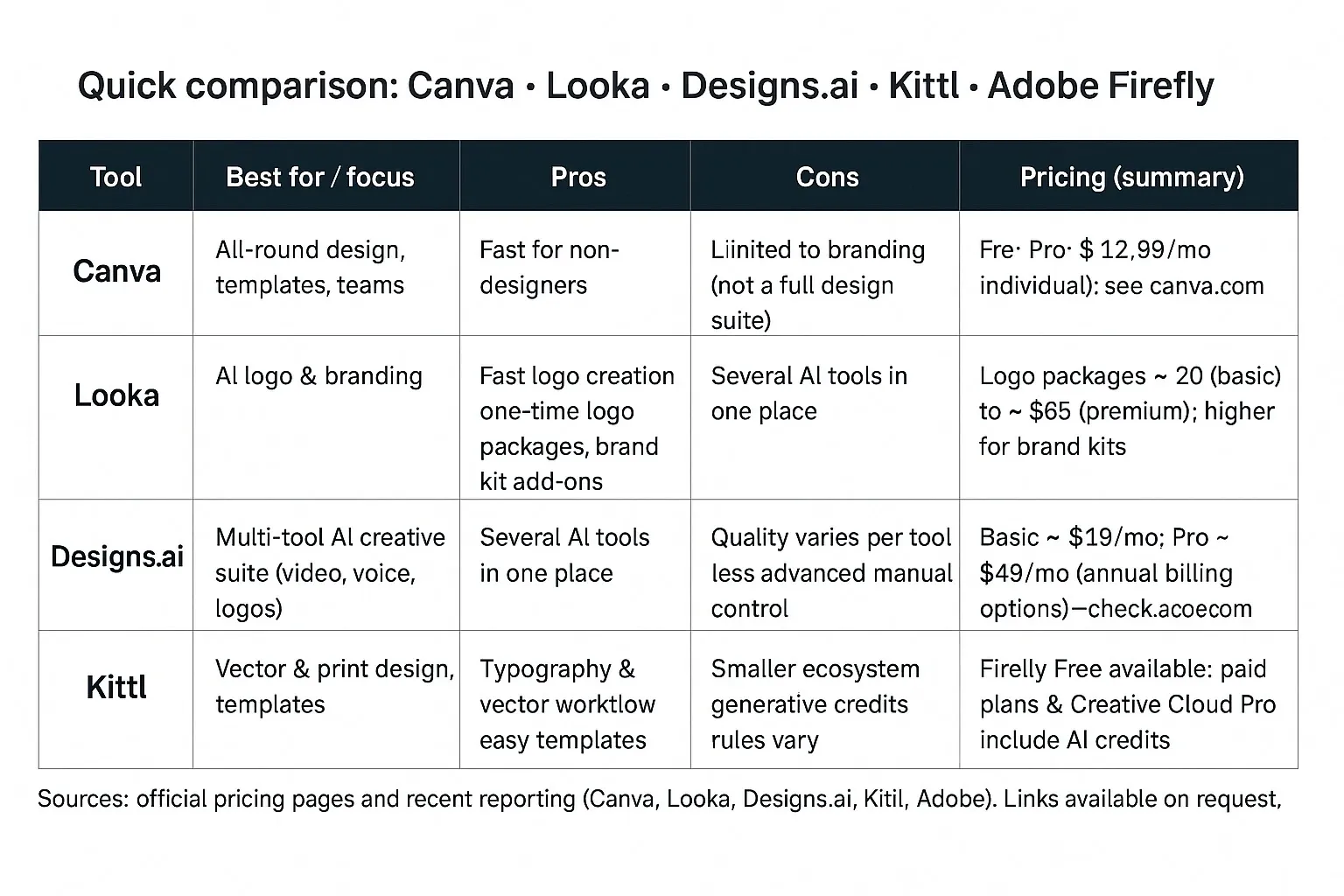
Mini Comparison: Best for Each Category
– Best for Beginners: Canva
– Best for Branding: Looka
– Best for Agencies: Designs.ai
– Best for Merch: Kittl
– Best for Professionals: Adobe Firefly

$500 PayPal Gift Card
A $500 PayPal gift card may be available to select users. Checking eligibility is quick. You can check if you’re one of them.
FAQs: AI Design Tools
Q: Can AI design tools fully replace human designers?
A: Not yet. They’re great for drafts and simple projects, but humans excel at creative strategy and unique branding.
Q: Are AI design tools free?
A: Most offer free plans, but premium templates and advanced features require subscriptions.
Q: Which AI tool is best for logos?
A: Looka is a strong option for quick, affordable logo generation.
Q: How do AI design tools help professionals?
A: They speed up repetitive tasks, allowing designers to focus on creativity and complex projects.
Bottom Line
AI design tools are powerful assistants, but they’re not full replacements for professional designers.
If you need speed and affordability, tools like Canva or Looka can help. But for high-impact, unique branding, human designers still have the edge.