₹30,000 Crore Boost: How Adani Plans to Shape Navi Mumbai Airport’s Future
See how the Adani Navi Mumbai project aims to reshape the region’s aviation future with a massive ₹30,000 crore investment. This concise teaser highlights the upgrades, strategic goals, and long-term impact driving the airport’s transformation.

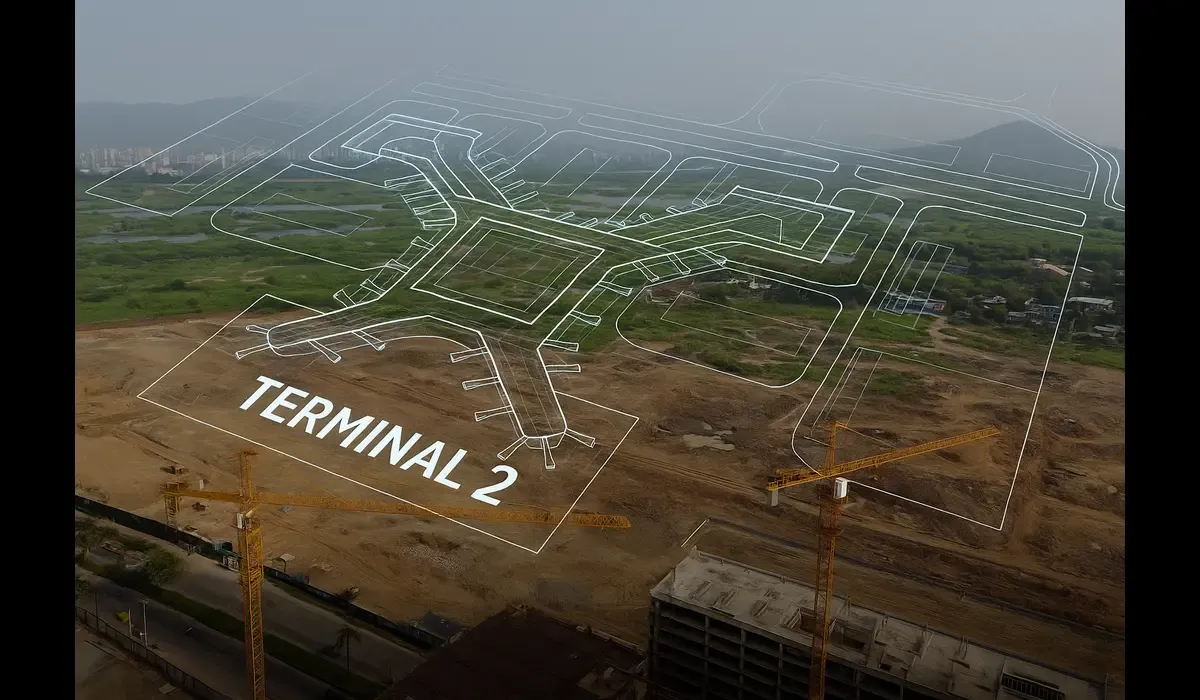
Adani Group funding for Navi Mumbai Airport Terminal 2 is now making headlines as the conglomerate seeks massive capital to scale the airport. With Terminal 1 just inaugurated, the push for the second terminal underscores Adani’s long-term ambitions.
- The group plans to raise ₹30,000 crore for Terminal 2.
- Funding will be through debt and equity, involving Indian and Japanese banks.
- Terminal 2 is expected to come online around 2029.
Latest Post
What Is Navi Mumbai Airport Terminal 2 Project?
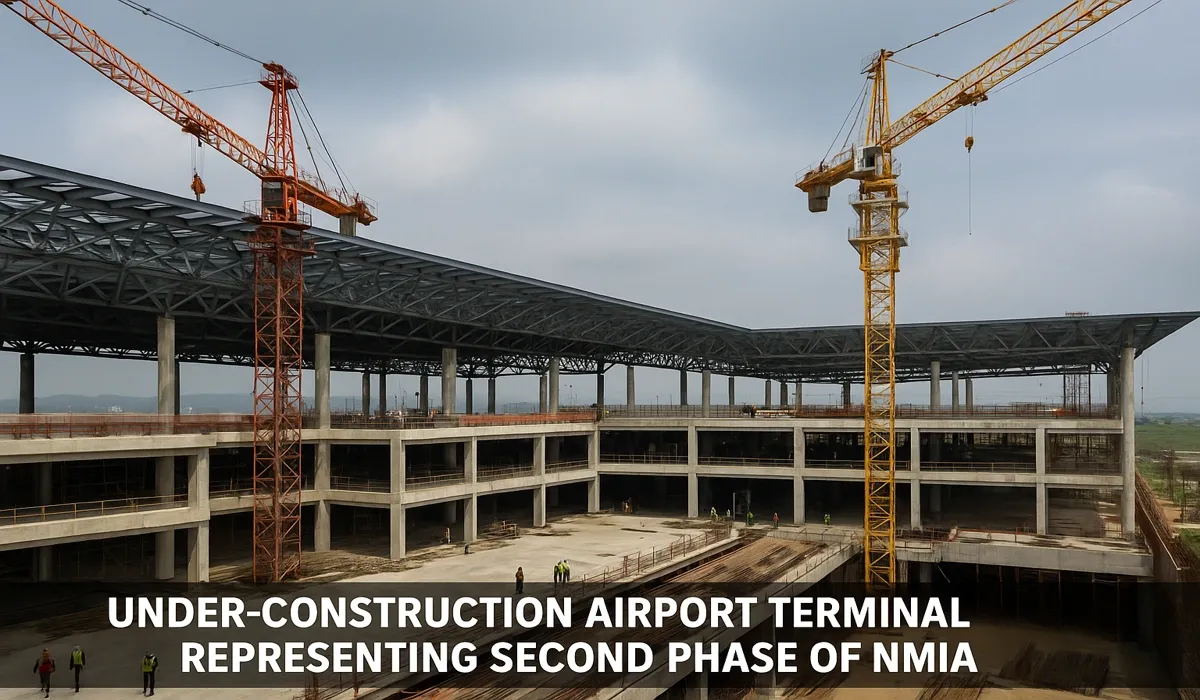
The second terminal (T2) is the upcoming expansion phase of the Navi Mumbai International Airport (NMIA), intended to boost capacity as the airport grows into a major aviation hub.
NMIA is developed via a public–private partnership between Adani and CIDCO under a DBFOT (Design, Build, Finance, Operate, Transfer) model.
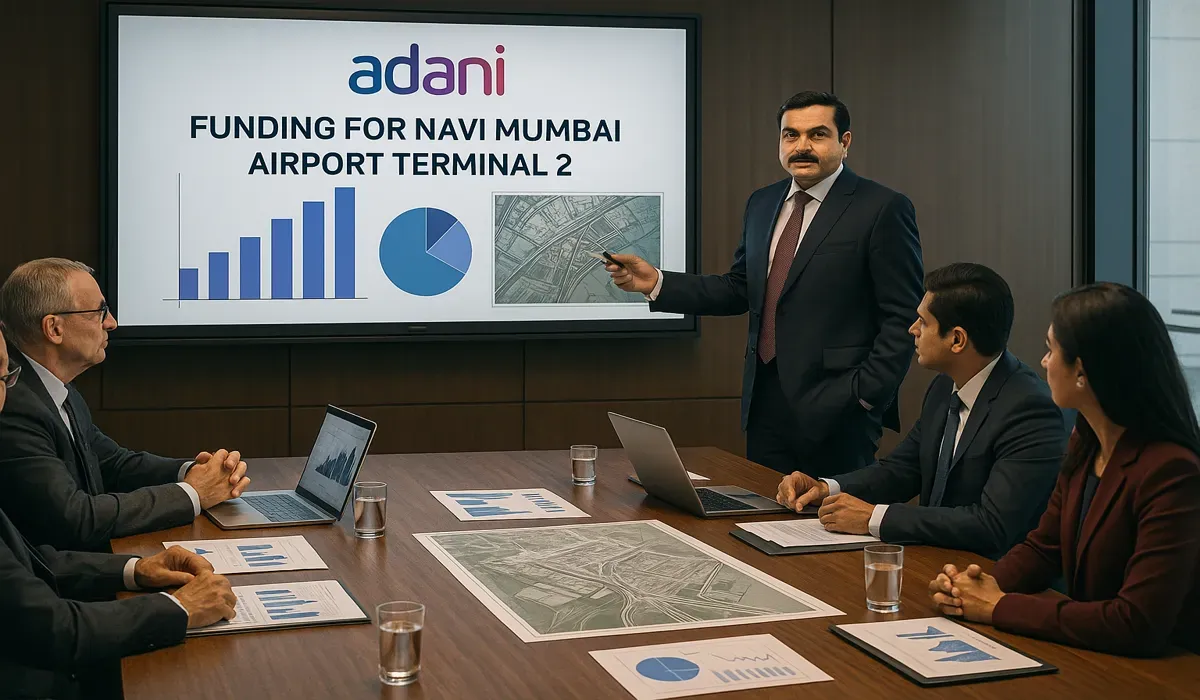
Latest Update: Funding Plan & Timeline
- Fundraising Goal: Adani intends to raise ₹30,000 crore for Terminal 2 development.
- Phasing & Timeline: Terminal 2 is projected to open by 2029.
- Early Capital Lock‐in: About ₹10,000 crore is expected to be secured within the first 6 months; remaining funds over the next 12–18 months.
- Funding Mix: Plans include debt from Indian & Japanese banks and promoter equity.
Key Features & Scale of Terminal 2
- Size & Capacity: T2 will span ~400,000 sq m (compared to 234,000 sq m of T1) and handle ~30 million passengers annually.
- Cost Basis: The ₹30,000 crore estimate is the cost for Terminal 2 alone.
- Integration & Design: T2 will add another terminal alongside T1 and will tie in infrastructure—runways, access roads, transit links.
- Airport Vision: Once all phases are done, NMIA aims to handle ~90 million passengers with multiple terminals and dual runways.
Why It Matters — Strategic & Economic Impact
- Relief for Mumbai Aviation: NMIA, with T2, will ease traffic pressure on Mumbai’s existing airport.
- Long-Term Growth: Additional capacity will support aviation growth in India’s largest city region.
- Investor Confidence: Successful funding and execution will enhance Adani’s aviation credentials.
- Local Development: The area around Navi Mumbai may see infrastructure, real estate, and economic activity rise with T2.
Comparisons & Alternatives
| Parameter | Terminal 1 | Terminal 2 (Planned) |
|---|---|---|
| Area | ~234,000 sq m | ~400,000 sq m |
| Passenger Capacity | ~20 million pa | ~30 million pa (when mature) |
| Cost Estimate | ₹19,650 crore for Phase 1 | ₹30,000 crore for T2 |
| Launch Timeline | Phase 1 inaugurated in 2025 | Expected operational by 2029 |
| Funding Approach | Mostly debt + equity for first phase | Larger debt + promoter equity, international banks involvement |
Expert Views & Industry Signals
- Adani’s airport division is already working to boost non-aeronautical revenue (retail, real estate) in NMIA.
- Analysts view the T2 funding push as a bold bet given rising interest rates and global capital constraints.
- Adani executives have spoken of NMIA matching top global airports in design and operational efficiency.
Practical Takeaways / What to Watch
- Monitor debt terms: Interest rates, tenure, covenants—these could affect cash flows.
- Equity involvement: How much promoter equity versus external investors will be key.
- Execution risk: Delay, cost overruns, regulatory clearances are challenges.
- Revenue planning: T2 must generate sufficient aeronautical and non-aeronautical revenues to service debt.
- Connectivity push: Integration with roads, metro, rail, and water transit will determine viability.
FAQs
Q1: Why does Adani need ₹30,000 crore just for Terminal 2?
Because T2 is larger in scale, more complex infrastructure, and higher capacity compared to Terminal 1’s initial phase.
Q2: When will Terminal 2 of Navi Mumbai airport become functional?
Terminal 2 is targeted to begin operations around 2029.
Q3: What is the source of the funding?
Funding will be a mix of debt (Indian & Japanese banks) and promoter equity.
Q4: How does T2 differ from T1?
T2 is significantly larger in area, higher capacity, infrastructure expansion, and integrated connectivity.
Key Takeaways
- Adani Group funding for Navi Mumbai Airport Terminal 2 is planned at ₹30,000 crore.
- Terminal 2 is expected to become operational by 2029.
- Funding will be via debt, equity, and international institutional financing.
- T2 promises higher capacity, expanded infrastructure, and deeper connectivity.
- Execution, revenue models, and managing funding risk will decide success.
Conclusion
Adani’s push to fund Terminal 2 at Navi Mumbai underscores the group’s ambition to make NMIA world-class. The ₹30,000 crore funding decision is bold, but critical to meeting India’s aviation growth trajectory. Terminal 2 won’t just expand capacity; it will shape the next phase of Mumbai’s air connectivity.